
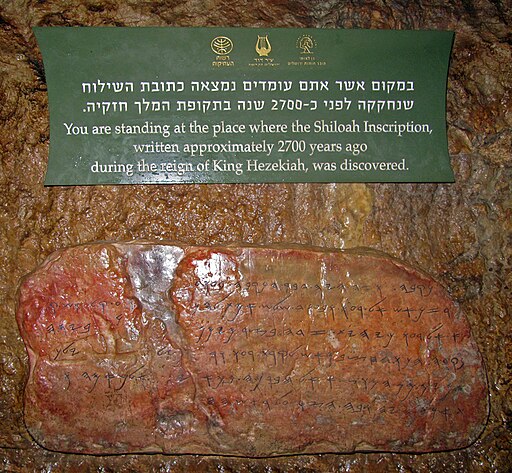
Hezekiah’s Tunnel and the Siloam Inscription found within the tunnels are fascinating archaeological discoveries that help confirm the historical reliability of the biblical description of Jerusalem’s infrastructure. The Siloam Inscription, dating to the late 8th century BC, documents a major engineering project undertaken to secure Jerusalem’s water supply during the Assyrian threat.
Together, Hezekiah’s Tunnel and the Siloam Inscription closely parallel the biblical accounts in 2 Kings 20:20 and 2 Chronicles 32:2–4, providing independent confirmation of Judah’s defensive preparations during the reign of King Hezekiah. Rather than serving to confirm theological claims, the tunnel and inscription anchor the biblical narrative in demonstrable historical, linguistic, and geopolitical realities.
🧭 Historical Context
In the late 8th century BC, the Kingdom of Judah was under the looming threat of the Assyrian Empire. Assyrian sources, including Sennacherib’s Annals, describe a military campaign against Judah in 701 BC, during which numerous fortified cities were destroyed and Jerusalem was placed under siege.1
Within this context, access to water was a critical military concern, as Jerusalem’s primary water source, the Gihon Spring, lay outside the city’s defensive walls. This led to the development of Hezekiah’s Tunnel, a massive hydraulic project designed to redirect the spring’s water into the city, ensuring a protected water supply during a siege.
2 Chronicles 32:30 directly attributes this project to King Hezekiah:
“Hezekiah… stopped the upper outlet of the waters of Gihon and directed them down to the west side of the City of David.” (2 Chronicles 32:30)
🛠️ Hezekiah’s Tunnel: Engineering and Purpose
Hezekiah’s Tunnel measures ~533 meters long and follows a deliberately winding, non-linear course. The tunnel was excavated simultaneously by two teams working from opposite ends through solid limestone bedrock, an approach that distinguishes it ancient water channels. and represents a notable engineering achievement for the Iron Age.2
Archaeological analysis reveals:
• Tool marks consistent with Iron Age technology
• Variations in tunnel width and height, suggesting real-time adjustments
• A final meeting point where the two teams successfully converged
Furthermore, stratigraphic analysis, paleographic study of the Siloam Inscription, and radiocarbon dating firmly place its construction in the late eighth century BC. Scholars now overwhelmingly attribute the project to the reign of King Hezekiah, with earlier proposals suggesting alternative dates largely set aside based on this combined evidence.2,3
📜 The Siloam Inscription
The Siloam Inscription carved within the southern exit of Hezekiah’s Tunnel commemorates the completion of the project. The inscription is written in Paleo-Hebrew script and describes the dramatic moment when the two excavation teams broke through to one another.5
The inscription describes the final stages of construction, noting how the sound of tools from one team could be heard by the other as they approached completion. Linguistically, the text closely aligns with Biblical Hebrew in vocabulary, grammar, and orthography, providing valuable data for the study of the Hebrew language in the late monarchic period.3
A portion of the inscription reads:
“While there were still three cubits to be cut through, the voice of one man was heard calling to another… and on the day of the breakthrough, the stonecutters struck, each toward the other, axe against axe, and the water flowed from the source to the pool…”5
Notably, the inscription does not mention King Hezekiah by name. This omission is consistent with the nature of the Siloam Inscription as “not a royal display inscription” that makes “no mention of the king or the deity,” reflecting a commemorative public work rather than royal propaganda and differing from contemporary royal epigraphic practices.6
📖 Relationship to the Biblical Record
The tunnel and inscription match the biblical descriptions in 2 Kings 20:20 and 2 Chronicles 32:2–4, yet they do so without using theological language or directly referencing the biblical texts. This independence is important, because it allows the archaeological evidence to serve as an external check on the biblical narrative.
2 Kings 20:20: “Hezekiah… stopped the upper outlet of the waters of Gihon and directed them down to the west side of the City of David.”
2 Chronicles 32:2–4: “Hezekiah trusted in the Lord, the God of Israel, so that after him came war with the Philistines and with the Assyrians. He fortified the city of David and made large weapons of war. He set commanders of war over the people and gathered them together to build up the wall.”
The archaeological evidence confirms that the tunnel existed, served a defensive purpose, and dates to the correct historical period. Rather than embellishing events or projecting later developments into the past, the biblical texts provide an accurate record of Jerusalem’s infrastructure and strategic planning during the Assyrian crisis.
📌 Why Hezekiah’s Tunnel Matters
Hezekiah’s Tunnel and the Siloam Inscription provide rare and direct evidence of Judah’s response to Assyrian imperial pressure. They confirm that Jerusalem possessed the administrative organization, engineering skill, and strategic foresight described in the biblical account.
Additionally, the scale of this project was fully realized in 2004 with the rediscovery of the Pool of Siloam, the monumental stepped reservoir where Hezekiah’s Tunnel emptied. This find not only confirms the tunnel’s terminus but bridges the gap between Hezekiah’s defensive engineering and the Jerusalem later described in the New Testament.
Far from being theological inventions or legendary embellishments, these discoveries demonstrate that both the Old and New Testament reflect historically grounded locations, events, and infrastructure that align with the archaeological record.
📝 Conclusion
Hezekiah’s Tunnel and the Siloam Inscription stand as one of the clearest points of convergence between archaeology and the biblical record. The physical remains of the tunnel, combined with an indigenous Hebrew inscription, confirm the historical credibility of Jerusalem’s defensive preparations during Hezekiah’s reign. Together, they illustrate that the biblical narrative is firmly rooted in the lived experience of ancient Judah and reflects the reliability of the Bible.
📚 References
- Younger, K. Lawson. Ancient Near Eastern Texts Relating to the Old Testament. 3rd ed. Edited by James B. Pritchard. Princeton University Press, 1969, pp. 287–288.
- Reich, Ronny, and Eli Shukron. “The Date of the Siloam Tunnel Reconsidered.” Tel Aviv, vol. 35, no. 2, 2008, pp. 147–157.
- Avigad, Nahman. “The Siloam Inscription.” Israel Exploration Journal, vol. 17, 1967, pp. 133–143.
- Mazar, Amihai. Archaeology of the Land of the Bible, 10,000–586 B.C.E. Doubleday, 1990, pp. 290–292.
- Lendering, Jona. “The Siloam Inscription.” Livius.org
- Rendsburg, Gary A., and William M. Schniedewind. “The Siloam Tunnel Inscription: Historical and Linguistic Perspectives.” Israel Exploration Journal 60 (2010): 188–203. Quoted excerpt available via Rutgers University research archive
- Image Credits: “Copy of the Siloam Inscription, placed in Hezekiah’s Tunnel (Siloam conduit).” Photograph by Tamar Hayardeni, Wikimedia Commons, August 2010. Creative Commons Attribution 3.0 Unported. https://commons.wikimedia.org/wiki/File:Siloam11.jpg

Leave a Reply