
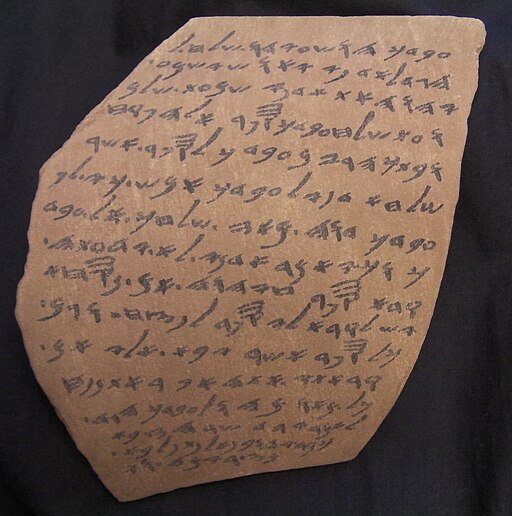
In the 6th century BC, as Babylonian armies tightened their grip on the Kingdom of Judah, military officers exchanged urgent dispatches across a crumbling countryside. Written in ink on broken pottery, these messages reported collapsing defenses and debated the “troubling words” of a prophet who claimed the war was already lost.1
Discovered more than 2,500 years later in the ruins of the fortress city of Lachish, these twenty-one “Lachish Letters” provide a rare, unfiltered glimpse into Judah’s final hours. The inscriptions are written in paleo-Hebrew on broken pottery fragments known as ostraca and date to the final years of the Kingdom of Judah, shortly before the destruction of Jerusalem. The Lachish Letters are not theological writings but rather preserve real military correspondence from the final generation before Judah’s collapse. Remarkably, Letters III and IV align closely with the prophetic and historical setting described in the Book of Jeremiah.
🧭 Historical Context: The Fall of Judah
During the late seventh and early sixth centuries B.C., the Babylonian Empire under Nebuchadnezzar II launched a series of campaigns against Judah following repeated rebellions by its kings. Babylon’s strategy involved systematically neutralizing Judah’s fortified cities before moving against Jerusalem itself.5
The Bible records that only a few strongholds remained during the final phase of the invasion in Jeremiah 34:7:
“The army of the king of Babylon was fighting against Jerusalem and against all the cities of Judah that were left, Lachish and Azekah, for these were the only fortified cities of Judah that remained.”
Archaeology confirms Lachish as one of Judah’s most important military centers during this period. Located roughly thirty miles southwest of Jerusalem, it served as a defensive gateway to the Judean hill country. Excavations uncovered massive fortifications, administrative structures, and the destruction layer associated with the Babylonian conquest of 586 B.C.4
It was within this destruction layer that the Lachish Letters were discovered, preserved as fragments of correspondence written in the final days before the city fell.
📜 Lachish Letter III: The Prophet Controversy
One of the most revealing Lachish Letters describes a dispute over a prophet whose message was seen as discouraging the war effort. Officials feared that his warnings were weakening the morale of soldiers and civilians during Babylon’s invasion, as seen in this widely-accepted reconstruction of Lachish Letter III:
“To my lord Yaosh:
May Yahweh cause my lord to hear tidings of peace at this very time.
And now, your servant has done according to everything which my lord sent word.
I have written on the sheet according to everything my lord sent to me.And as for the matter about which my lord wrote to me, saying: ‘Beware!’
the words of the prophet are not good, weakening the hands of the people and the soldiers who hear them.”
Remarkably, this aligns with the complaint against Jeremiah recorded in Jeremiah 38:4:
“This man is weakening the hands of the soldiers who remain in this city.”1
The wording is remarkably close to the language used in Jeremiah. Both texts accuse a prophet of “weakening the hands” of the people and soldiers, a rare phrase used to describe discouraging resistance during wartime. Because of this overlap, many historians see the letter as reflecting the same tension described in Jeremiah: a conflict between officials urging continued resistance and prophetic voices warning that Babylon’s victory was inevitable.3
However, the letter does not name Jeremiah, and scholars remain cautious about making a direct identification. Nevertheless, it shows that prophetic warnings discouraging resistance were circulating in Judah during the Babylonian invasion, reinforcing the historical context described in the Book of Jeremiah.
While Letter III reveals the internal tensions within Judah during the crisis, another Lachish letter captures the military situation unfolding on the battlefield.
📜 Lachish Letter IV: The Signal Fires of Azekah
Perhaps the most famous of the Lachish ostraca is Letter IV, which concerns Judah’s military communication system:
“May Yahweh cause my lord to hear good news today.
And now, according to all the signs which my lord gave, so has your servant done.We are watching for the signals of Lachish according to all the indications which my lord gave,
for we cannot see Azekah.”
The phrase “we cannot see Azekah” has drawn particular scholarly attention because it reflects the same military situation described in Jeremiah 34:7.
Ancient fortified cities often communicated using signal fires, allowing messages to be transmitted across large distances. The letter indicates that Lachish expected to see signal fires from the nearby fortress of Azekah but could no longer observe them.6
Many historians interpret this as evidence that Azekah had already fallen to Babylonian forces, leaving Lachish as one of the last remaining strongholds. If correct, the letter captures a moment that aligns closely with the biblical statement in Jeremiah 34:7, which identifies Lachish and Azekah as the final fortified cities resisting Babylon.
When read alongside the Book of Jeremiah, the Lachish Letters offer a rare glimpse into the military collapse and prophetic tensions that shaped Judah’s final days.
🌟 Why the Lachish Letters Matter
The significance of the Lachish Letters lies in their ordinary nature. These were not religious texts written to defend a doctrine, but rather routine military communications written by soldiers trying to survive a national crisis.
For this reason, their overlap with the biblical narrative carries significant weight:
- Historical Context: The letters confirm that Judah’s final years were marked by military pressure, collapsing fortifications, and political conflict.
- Biblical Environment: The themes found in the letters, including prophetic controversy and defensive communication networks, closely mirror the historical setting described in the Book of Jeremiah.
- Archaeological Insight: The ostraca preserve authentic Hebrew writing from the First Temple period, offering a rare glimpse into everyday communication during the biblical era.
Together, these discoveries demonstrate that the biblical account of Judah’s final days is embedded within a historically credible political and military environment.
📝 Conclusion
The Lachish Letters offer one of the most vivid archaeological glimpses into Judah’s final days before the destruction of Jerusalem. Written by soldiers stationed in a frontier fortress, these fragments of military dispatches reveal the fear, uncertainty, and political tension of a kingdom under siege.
Although the letters were never intended to confirm the Bible, they illuminate the same historical landscape described in the Book of Jeremiah. They preserve firsthand communications from the final days of Judah’s resistance. In doing so, the Lachish Letters anchor the biblical account of the Babylonian invasion within the documented history of ancient Judah.
📚 References
- Torczyner, Harry (Naftali Herz Tur-Sinai). The Lachish Letters. Oxford University Press, 1938.
- The original scholarly publication of the Lachish ostraca, including the first full translations and historical analysis.
- Albright, William F. “The Lachish Letters.” Bulletin of the American Schools of Oriental Research.
- Early archaeological analysis discussing the historical significance of the letters for the final years of Judah.
- Na’aman, Nadav. “The Lachish Letters and the Final Phase of Judah.” Israel Exploration Journal.
- Modern historical study examining the letters within the political and military context of Babylon’s invasion of Judah.
- Mazar, Amihai. Archaeology of the Land of the Bible. Yale University Press, 1990.
- Comprehensive overview of the archaeology of ancient Israel, including Lachish and the Babylonian destruction of Judah.
- Kitchen, K. A. On the Reliability of the Old Testament. Eerdmans, 2003.
- Scholarly defense of the historical reliability of the Old Testament using archaeological and historical evidence.
- Finkelstein, Israel, and Nadav Na’aman, eds. The Fire Signals of Lachish: Studies in the Archaeology and History of Israel in the Late Bronze Age, Iron Age, and Persian Period in Honor of David Ussishkin. Eisenbrauns, 2011.
- Academic collection exploring the archaeological and historical background of Lachish, including the signal-fire system referenced in the letters.
- Image Credits: “Front side of a replica of Lachish Letter III.” Photograph by NenyaAleks, Wikimedia Commons, March 2010. Public Domain (PD-self). https://commons.wikimedia.org/wiki/File:Lachish_III_obv.JPG

Leave a Reply