
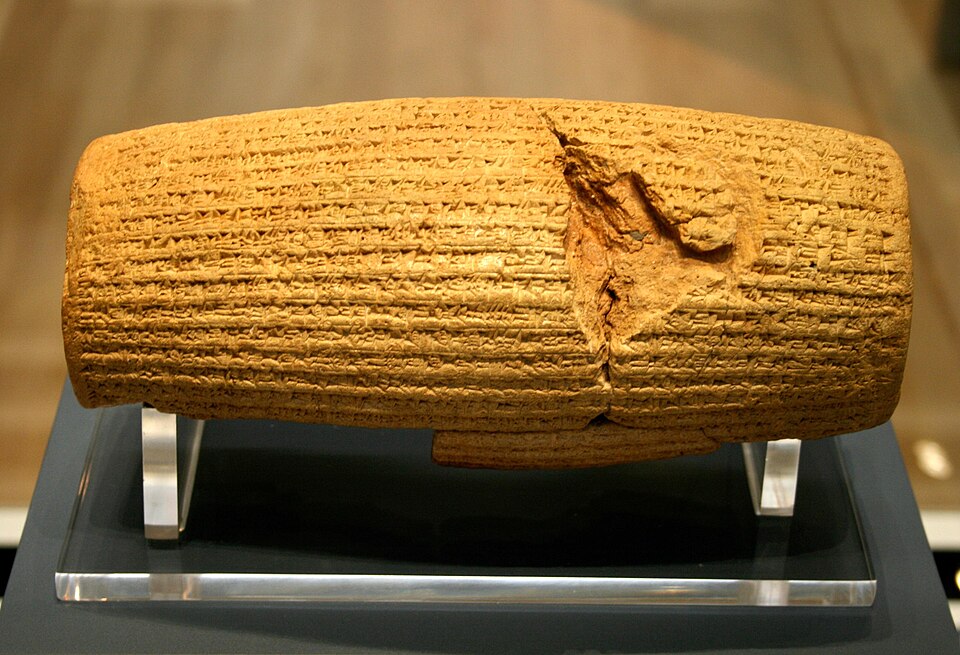
The Cyrus Cylinder is a clay artifact dated to 539 B.C. that records Persian policies of temple restoration, repatriation of displaced peoples, and religious accommodation.1 These inscriptions show remarkable parallels to the biblical Books of Ezra and 2 Chronicles and, importantly, provide the historical foundation for Daniel 9’s seventy-week prophecy. By confirming the existence of a royal decree to rebuild Jerusalem, the Cylinder anchors the prophecy’s timeline in real events, demonstrating that the biblical narrative is grounded in historical reality rather than later invention.
🧭 Historical Context
After capturing Babylon in 539 BC, Cyrus II sought to distinguish his rule from earlier Babylonian kings, who were remembered for temple destruction, forced deportations, and religious suppression. Persian rule, by contrast, emphasized political stability through the restoration of local religious institutions and the repatriation of displaced populations.2 This strategy helped secure loyalty among newly conquered peoples and reduced the likelihood of rebellion.
These policies included:
- Restoration of damaged or neglected temples
- Return of cultic images or sacred property
- Repatriation of displaced peoples to their homelands
- Promotion of imperial stability through religious tolerance
📜 The Cyrus Cylinder and Repatriation Policy
The clearest evidence for this policy appears in the Cylinder’s so-called “repatriation section,” which describes the return of both deities and populations to their original locations. Lines 30–35 state:
“From [Shuanna] I sent back to their places to the city of Ashur and Susa, Akkad, the land of Eshnunna, the city of Zamban, the city of Meturnu, Der, as far as the border of the land of Guti—the sanctuaries across the river Tigris—whose shrines had earlier become dilapidated, the gods who lived therein, and made permanent sanctuaries for them. I collected together all of their people and returned them to their settlements…”4
This passage demonstrates a coordinated imperial effort to reverse earlier deportations and restore religious infrastructure throughout the empire.
📖 Relationship to the Bible
In this historical context, the biblical claim that Cyrus authorized the return of Jewish exiles and the rebuilding of the Jerusalem Temple aligns precisely with known Persian practice.
For many years, scholars dismissed the biblical decrees in Ezra and Chronicles as theological invention. However, the Cyrus Cylinder, along with broader Persian administrative evidence, shows that Cyrus routinely allowed displaced peoples to return home and restore local temples. This policy is further confirmed by Persian records, the Elephantine papyri6, and the continuation of temple restoration under Darius I.3 Ezra 1:1–4 and 2 Chronicles 36:22–23 therefore reflect a historically credible imperial practice rather than a later legend.
2 Chronicles 36:22-23 states:
22 In the first year of Cyrus king of Persia, in order to fulfill the word of the Lord spoken by Jeremiah, the Lord moved the heart of Cyrus king of Persia to make a proclamation throughout his realm and also to put it in writing:
23 “This is what Cyrus king of Persia says:
“‘The Lord, the God of heaven, has given me all the kingdoms of the earth and he has appointed me to build a temple for him at Jerusalem in Judah. Any of his people among you may go up, and may the Lord their God be with them.
Although the Cyrus Cylinder does not mention Jerusalem or Judah specifically, it confirms that such decrees were consistent with Persian imperial policy rather than an isolated or implausible claim unique to the biblical tradition.
✨ Theological Framing
Localized Decrees
One of the most significant points of comparison between the Cyrus Cylinder and the biblical texts lies in how Cyrus’s authority is theologically interpreted. When analyzing localized Persian decrees, scholars observe that the administrative action remains consistent, while the religious framing adapts to the audience being addressed.
- The Babylonian Version: On the Cyrus Cylinder, the god Marduk is credited with selecting Cyrus to restore order and justice to Babylon.
- The Biblical Version: In Ezra 1:2 and Isaiah 45:1, the God of Israel is identified as the one who appointed Cyrus as His “shepherd” and instrument of restoration.
This pattern suggests that multiple versions of Cyrus’s proclamations likely circulated, each expressed in the religious language appropriate to a given community. The Cylinder reflects a Babylonian theological framework, while the biblical text preserves the version meaningful to the Jewish exiles.
| Point of Comparison | Cyrus Cylinder (Babylonian) | Book of Ezra (Biblical) |
| Supreme Deity | Marduk | Yahweh (The LORD) |
| The Mandate | “Marduk… took Cyrus by the hand” | “The Lord… appointed me” |
| The Injustice | Neglect of Babylonian cults | Destruction of Jerusalem Temple |
| Restoration | Return of Idols/Statues | Return of Temple Vessels |
| The Request | Pray to Marduk for Cyrus | Pray for the life of the King |
Sacred Property Convergence
A further point of convergence between the Cyrus Cylinder and the biblical account concerns the restoration of sacred property. The Cylinder emphasizes the return of divine images to their sanctuaries, while the biblical narrative highlights the return of temple vessels rather than idols:
“King Cyrus also brought out the articles belonging to the temple of the Lord, which Nebuchadnezzar had carried away from Jerusalem…” (Ezra 1:7)
This difference reflects a key cultural distinction. Because Israelite religion was aniconic and prohibited physical representations of God, there were no statues to restore. In this context, the gold and silver vessels taken from the Jerusalem Temple functioned as the cultic equivalent of the idols mentioned on the Cylinder. Their return aligns closely with the Persian policy of restoring the religious life of displaced peoples.
🌟 Daniel 9 and the Historical Anchor
The historical confirmation of Cyrus’s decree provides more than background: it provides the historical context of Daniel 9’s prophecy. Daniel 9:24–27 establishes a timeline of seventy “weeks” (shavuim), or 490 years, with the countdown beginning at a decree to “restore and rebuild Jerusalem.”
Scholars often distinguish between the various stages of Persian authorization:
- The Decree of Cyrus (539 B.C.): Initiated the return of the people and the rebuilding of the Temple (as seen on the Cyrus Cylinder).
- The Decree of Artaxerxes (457 B.C.): Provided the full administrative authority to restore the city’s civil structure and walls (Ezra 7).
By providing independent historical evidence that the Persian “decree system” actually existed, the Cyrus Cylinder anchors the starting point of this prophecy in real events. It demonstrates that the administrative mechanisms described in Ezra and Daniel were not retroactive inventions, but documented imperial protocols. Anchoring the prophecy to a verifiable imperial action strengthens the credibility of the seventy-week framework and supports the view that the 69 weeks of years leading to the Messiah are grounded in a sequence of real historical events.
📌 Key Takeaways: Why the Cyrus Cylinder Matters
- Historical Validation: It provides external, archaeological proof that the Persian “repatriation policy” described in the Bible was a standard imperial practice, not a later theological myth.
- Literary Context: It explains why the Book of Ezra uses specific Persian legal language. By comparing the Cylinder to the Bible, we see how Cyrus used “Religious Localization” to speak to different cultures in their own theological “tongue.”
- Prophetic Foundation: It establishes the “legal track” for the restoration of Jerusalem. By verifying that Persian kings issued such decrees, the Cylinder anchors the Daniel 9 prophetic timeline in a verifiable historical era.
📝 Conclusion
The Cyrus Cylinder does more than shed light on Persian administrative policy; it provides tangible confirmation that the biblical narrative is historically reliable. The decree to rebuild Jerusalem, attested in both Scripture and Persian records, anchors the seventy-week prophecy of Daniel 9 in real history. Far from being a theological invention or retroactive legend, the prophecy unfolds from a verifiable event, demonstrating that Scripture accurately reflects historical realities. Scholars who once dismissed Ezra’s account are confronted with independent evidence showing that the prophetic timeline is not only plausible but firmly grounded in fact, reinforcing the integrity and trustworthiness of God’s Word.
📚 References
- Finkel, Irving. The Cyrus Cylinder: The King of Persia’s Proclamation from Ancient Babylon. I.B. Tauris, 2013.
- Kuhrt, Amélie. “The Cyrus Cylinder and Achaemenid Imperial Policy.” Journal for the Study of the Old Testament, vol. 8, no. 25, 1983, pp. 83–97.
- Bickerman, Elias J. “The Edict of Cyrus in Ezra 1.” Journal of Biblical Literature, vol. 65, no. 3, 1946, pp. 249–275.
- British Museum. “The Cyrus Cylinder.” Official Museum Research Resource.
- Steinmeyer, N. (2025). “The Cyrus Cylinder: A Persian edict and the return of the Judean exiles.” Bible History Daily, Biblical Archaeology Society.
- Porten, Bezalel. The Elephantine Papyri in English: Three Millennia of Cross-Cultural Continuity and Change. Leiden: Brill, 1996.
- Image Credits: Cyrus Cylinder (Featured Image): The Cyrus Cylinder by Prioryman is licensed under CC BY-SA 3.0.
Leave a Reply