
The Nazareth Decree
The Nazareth Decree is a Greek inscription carved on a marble slab that outlines a Roman imperial order against disturbing graves. While its origin is debated, its unusual call for capital punishment for tomb-breaking has drawn attention in discussions of early Christianity and the resurrection.
🧭 Introduction
The Nazareth Decree, also known as the Nazareth Inscription, was acquired in 1878 by collector Wilhelm Fröhner. The stone was labeled as having been “sent from Nazareth,” a designation that later gave rise to its modern name. However, scholars have noted that Nazareth was an unlikely location for the public display of an imperial edict. Similar decrees were typically posted in major administrative centers such as Jerusalem or Caesarea.
The decree has attracted special attention among scholars and apologists because of its thematic overlap with the Gospel accounts of Jesus’s empty tomb and the polemical claim, found in Matthew 28:11–1511 While they were going, behold, some of the guard went into the city and told the chief priests all that had taken place. 12 And when they had assembled with the elders and taken counsel, they gave a sufficient sum of money to the soldiers..., that the disciples had stolen Jesus’s body. Some have proposed that the edict was a Roman response to the resurrection narrative spreading from Jerusalem. Others, however, have pushed back on this interpretation, especially in light of recent findings.
📜 Text of the Nazareth Decree (Translation)
“It is my decision [concerning] graves and tombs—whoever has made them for the religious observances of parents, or children, or household members—that these remain undisturbed forever. But if anyone legally charges that another person has destroyed, or has in any manner extracted those who have been buried, or has moved with wicked intent those who have been buried to other places, committing a crime against them, or has moved sepulcher-sealing stones, against such a person, I order that a judicial tribunal be created... even more so will it be obligatory to treat with honor those who have been entombed... But if [someone does], I wish that [violator] to suffer capital punishment under the title of tomb-breaker.”
⚖️ Three Theories of Origin
Scholars generally agree that the inscription is authentic and date it broadly to the first century BC–first century AD based on its letter forms and style, but they differ significantly in interpreting its origin, context, and purpose. These differences have given rise to three leading theories:
1. The Resurrection Response (Minority View)
This interpretation proposes the edict was issued under Emperor Claudius (AD 41–54) as a reaction to unrest caused by reports of Jesus’s empty tomb and rumors that his body had been stolen.2
Pros
-
Thematic Specificity: The decree focuses on moving bodies with "wicked intent" (dolus malus). This mirrors the specific charge in Matthew 28:1313 and said, “Tell people, ‘His disciples came by night and stole him away while we were asleep.’ — that the disciples didn't just move the body, but did so to facilitate a deception.
-
Chronological Alignment: Paleographic analysis places the inscription from the late 1st century BC into the early Roman Empire.4 This range fits more comfortably within an early Imperial administrative context than with a specific late-Republic event like the Nikias incident, though the dating remains too broad to confirm a precise historical catalyst.
-
Linguistic Coherence: The term katochous (sealing stone) describes the specific mechanics of a rolling-stone tomb. These were most commonly found in Judea during this period, particularly for the elite.
-
Historical Context: Emperor Claudius was known for intervening in Jewish-Christian disputes (e.g., the Edict of Claudius in AD 49 which expelled Jews from Rome due to "disturbances at the instigation of Chrestus").8
Cons
-
Lack of Explicit Identification: The inscription does not name Jesus or Judea, requiring the connection to be inferential.
-
Absence of Documentation: No surving records or documents explicitly link this specific decree to the disturbances in Jerusalem.
-
Material Disconnect: As the 2020 study shows, the physical stone is Koan marble.3 Currently, there is no archaeological evidence of a "blank slab" trade of this specific marble into Judea for official use.
2. The Imperial Decree
This view holds that the decree is a standard imperial decree addressing grave desecration, possibly intended for a volatile province like Judea or the Decapolis.
Pros
-
Administrative Standard: The style fits other known Roman rescripts issued to maintain public order in the provinces.
-
Chronological Alignment: The lettering style (paleography) is consistent with the early Imperial period.
Cons
-
The Punishment Gap: Under standard Roman Law (The Digest), tomb-robbing was a civil offense or a "religious violation" punished by fines. Jumping to capital punishment is extreme and suggests that these "violations" may have been used to incite political rebellion or riots.
-
Lack of Replication: A "General Decree" should leave a trail of multiple inscriptions across the Empire. The fact that this text is unique suggests it was triggered by a singular, "one-off" event rather than a general change in Roman law.
-
**Material Evidence: **Archaeological records contain no evidence of marble imported from Kos.4
3. The Local Kos Theory (Majority View)
Following the 2020 isotopic analysis of the marble, many specialists argue that the inscription was likely carved on Kos and may relate to local events on that island — specifically, the desecration of the tomb of a local ruler (the tyrant Nikias), which would have prompted Roman intervention under Augustus.4
Pros
-
Material Provenance: The 2020 Pellegrino study used stable isotope analysis to confirm the marble is proconnesian-like marble from Kos, providing the first physical link to the island.4
-
Historical Scandal: Nikias was a 1st-century BC tyrant. After his death in ~20 BC, the population dragged his corpse through the streets in protest.
-
The "Augustus-Kos" Connection: Some reconstructions suggest Emperor Augustus may have had political incentive to protect elite tombs on Kos. His close friend and physician, Gaius Stertinius Xenophon, was from Kos, and Augustus himself was likely involved in the island's politics after the civil wars.7 A decree protecting local "elite" tombs fits his pattern of rewarding loyal territories.
Cons
-
Lack of Explicit Identification: The inscription does not name Nikias or Kos, requiring the connection to be inferential.
-
Paleographic Gap: While the dating range overlaps with the Nikias incident, it does not center clearly on that period. The inscription is more commonly discussed within an early Imperial context, leaving the proposed link to Nikias possible but not clearly established.
-
Technological Mismatch: The decree forbids moving "sealing stones" (katachos), yet the tomb of Nikias utilized "bolted doors" (ochēas), a completely different mechanism.
🔍 The Linguistic Debate
One of the strongest pieces of evidence for a Judean connection is the Greek phrase κατόχους ἤ λίθους (katochous ē lithous), translated as "sealing-stones or [other] stones."
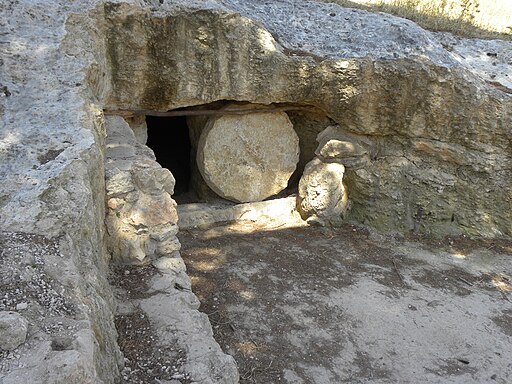
The language of the inscription itself points to a specific burial practice. According to the LSJ Greek Lexicon, katachos refers to something that “holds down” or “seals,” a meaning that fits well with the massive circular stones used to close rock-cut tombs in Judea. Archaeologically, this term is associated with the heavy rolling stones designed to block the entrance of elite tombs, rather than with simple graves or reused burial caves.3
This terminology closely matches the Gospel description of Jesus’ burial in the tomb of Joseph of Arimathea, who is identified as both a wealthy man (Matthew 27:5757 When it was evening, there came a rich man from Arimathea, named Joseph, who also was a disciple of Jesus.) and a prominent member of the council (Mark 15:4343 Joseph of Arimathea, a respected member of the council, who was also himself looking for the kingdom of God, took courage and went to Pilate and asked for the body of Jesus.). Matthew records that Joseph laid the body in his own new tomb and “rolled a great stone to the entrance of the tomb” (Matt. 27:59–6059 And Joseph took the body and wrapped it in a clean linen shroud 60 and laid it in his own new tomb, which he had cut in the rock. And he rolled a great stone to the entrance of the tomb and...).
Importantly, fewer than two percent of the more than nine hundred tombs excavated around Jerusalem include the carved track required for such rolling stones, highlighting how rare and expensive this burial type was. This level of exclusivity suggests the decree was aimed at high-status burials, rather than ordinary tombs, consistent with the elite context described in the Gospels.3
🏛️ The Material Debate
While the geochemical analysis points to the Greek island of Kos, the historical context of the era opens up the possibility of Koan marble being imported to the Judean region.
Herod the Great’s Ties to Kos
Herod the Great, king of Judea, maintained unusually close ties with the island of Kos. Ancient sources, especially Josephus, record that Herod made substantial financial donations to the city and even served as a benefactor of its Olympic Games. His court was thoroughly Hellenized, and he regularly moved within the social and political circles of the Aegean world.4
Even so, a major archaeological problem remains. There is no clear evidence that marble from Kos was ever used in Judea during the 1st century. Excavations at Herod’s most ambitious building projects, including Caesarea Maritima, show that he did not construct with imported marble. Instead, local kurkar stone was used and then coated with fine white stucco to imitate the look of costly Roman marble.
Some scholars suggest that, even if large quantities of marble were never imported, a Roman official might have obtained a single, uninscribed slab of Koan marble through private trade or administrative channels for the purpose of carving an imperial decree. This is possible, given the movement of goods around the Roman Mediterranean and Herod’s known connections to Kos. Still, this explanation remains hypothetical. It depends on what could have happened rather than on any direct archaeological or inscriptional evidence that Koan marble was actually imported or used in Judea.
📊 Theory Comparison
| Evidence Type | Resurrection Theory | Imperial Decree Theory | Local Kos Theory |
|---|---|---|---|
| Material (Marble) | ❌ (Kos marble complicates Judean origin) | ❌ (Unusual source for imperial posting) | ✅ (Strong isotopic match to Kos) |
| Language (Katochos) | ✅ (Fits Judean tombs) | ✅ (Fits Judean tombs) | ❌ (Doesn't fit Kos tombs) |
| Penalty (Death) | ✅ (Compatible with unrest or deterrence) | ❌ (Unusually severe under Roman law) | ✅ (Possibly consistent with political revenge) |
| Date (Letter style) | ✅ (Chronologically compatible) | ✅ (Comfortably within range) | ✅ (Compatible but not decisive) |
🔚 Conclusion:
Because the inscription contains no explicit geographical markers, the "Nazareth Decree" remains an open case in the halls of archaeology. However, when the evidence is weighed, the Kos Theory struggles against one significant hurdles: the architectural mismatch regarding "sealing stones."
Conversely, the Resurrection Response and Imperial Decree theories align linguistically and with the elite burial customs of Judea, but crucially lack direct evidence that Koan marble was imported for decrees.
Ultimately, the Nazareth Inscription is a potential data point rather than a proof. However, its value increases when viewed through the lens of Biblical archaelogical corroboration. When placed alongside several other archaeological discoveries such as the Caiaphas Ossuary and the Pilate Stone, the decree becomes a potential part of a vast cumulative case for the historical reliability of Gospel accounts.
📚 References
Nazareth Inscription (Nazareth Decree). Translation and commentary: Early Church Texts – Nazareth Inscription
Habermas, G. R. (1996). The Historical Jesus: Ancient Evidence for the Life of Christ. Book Overview/Purchase.
Kloner, A. (1999). "Did a Rolling Stone Close Jesus’ Tomb?" Biblical Archaeology Review 25(5). Article Access via BAS.
Pellegrino, G. V., et al. (2020). "Geochemical provenancing of the Nazareth Inscription: A Roman imperial edict on stone." Journal of Archaeological Science: Reports 30. Full Study via ScienceDirect.
Liddell, H.G., & Scott, R. A Greek-English Lexicon (LSJ).
W.R. Paton, tr., The Greek Anthology, Vol. 3 (New York: G.P. Putnam’s Sons, 1917), p. 43.
Josephus, Flavius. Antiquities of the Jews. Translated by William Whiston. Written c. 93–94 AD.
Suetonius, Claudius 25.4, in The Twelve Caesars, trans. Robert Graves (London: Penguin Classics, 1957).
Comments
No comments yet. Be the first to share your thoughts.